
As a story grows, its chronology often becomes increasingly difficult to manage. Characters travel, grow older, separate and meet again. Some events happen simultaneously, while others are only revealed several chapters after they actually occurred. Flashbacks shed light on the past, and time jumps may move the story forward by weeks or even years.
At the beginning of the writing process, all this information may seem easy to remember. However, once the manuscript becomes longer, a small change can create a series of inconsistencies: a character learns something too early, a journey takes less time than it should, a pregnancy lasts fifteen months, or an object reappears before it has even been discovered.
**A novel timeline is not simply a place to record dates. It helps you understand the real sequence of your entire story.**
Story chronology is not chapter order
Before building a timeline, it is important to distinguish between two different elements.
Narrative order is the order in which readers discover the story. It depends on the arrangement of chapters, changes in point of view, memories and revelations.
Chronological order represents when events actually happen within the fictional world.
These two orders may be identical in a linear story. They can also be completely different.
A novel might begin with a character’s disappearance, return ten years into the past to explore their childhood, and then alternate between the current investigation and several earlier events. The chapters are arranged to create suspense, but every event still occupies a precise place in the story’s chronology.
A timeline preserves this real chronology independently of the order in which scenes appear in the manuscript.
Why should you create a timeline for your novel?
A timeline becomes particularly valuable when your story includes:
several main characters;
parallel storylines;
significant journeys or changes of location;
flashbacks and flashforwards;
time jumps;
a mystery that depends on the exact order of clues;
a story spanning several generations;
several books sharing the same chronology.
It also helps you track the duration of events. A war, a period of training, a relationship, an illness or a sea voyage does not happen at one isolated moment. It occupies a period of time during which other actions may also take place.
Displaying these periods prevents every part of the story from being treated as an unrelated point.

Choose a simple chronological reference
In Plumelisse, every event can be placed freely on the timeline using a numerical position, including a negative one. Your fictional world therefore does not need to use the modern calendar, and you do not need to know the exact date of every scene immediately.
You can select one central event as your reference point:
position 0: the beginning of the novel;
negative positions: earlier events;
positive positions: later events.
In a contemporary story, one position might represent one day. In a family saga, it might represent one year. For a densely plotted story, you can use a more precise scale.
What matters most is choosing a consistent system and maintaining it throughout the project.
Your zero point can also represent a defining event in the fictional world: the beginning of a war, the disappearance of a character, the protagonist’s arrival in a city or the launch of an expedition.
**The best chronological system is not necessarily the most detailed one. It is the one you can understand and maintain throughout the writing process.**
Begin with the events that structure the story
You do not need to turn every gesture or conversation into a timeline event.
Start by placing the major landmarks of the story:
events belonging to your characters’ pasts;
the main inciting incident;
important meetings, separations and revelations;
changes of location;
major turning points;
the climax;
the final consequences.
This initial structure already provides a clear view of the overall shape of the plot. You can then gradually add secondary events that genuinely affect the chronology.
This approach prevents the timeline from becoming overloaded before you have established the foundations of the story.
Distinguish precise events from events with a duration
Plumelisse’s timeline supports two types of events.
A precise event represents an identifiable moment: a birth, an attack, a discovery, a meeting or a revelation.
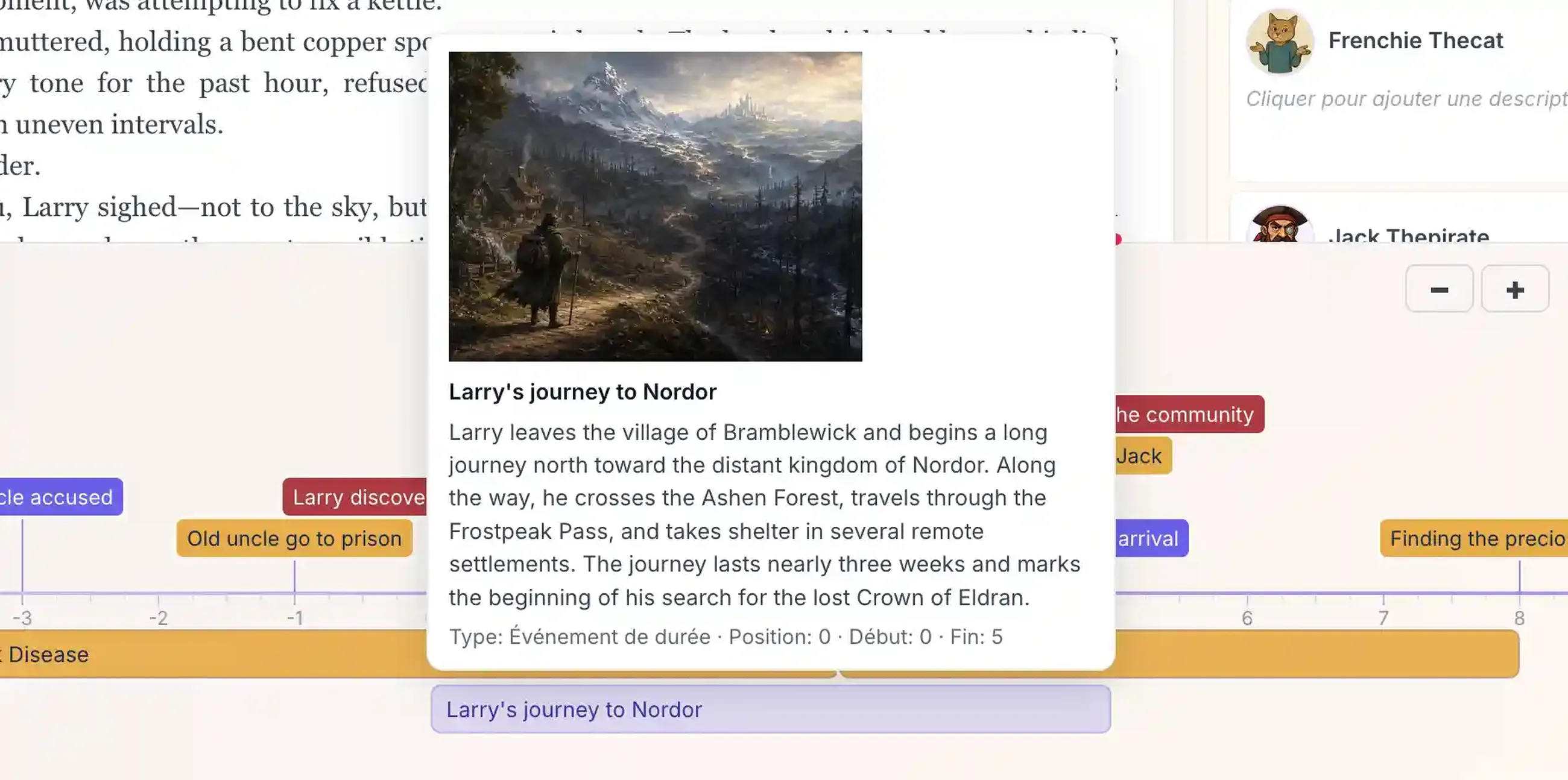
A duration event extends from a beginning to an end: a journey, a war, a period of captivity, a relationship, an investigation or a training period.
This distinction is essential when you need to understand what is happening simultaneously.
Imagine that one character spends thirty days at sea. During the same period, another character may be investigating events in the capital while an army begins moving towards the border. By displaying these actions as periods, you can immediately see that they overlap.
You can then check whether the characters genuinely have enough time to act, travel and eventually meet.
Give every event a title you can understand immediately
A title such as “Important conversation” may become meaningless a few months later.
Use wording that clearly describes what happens:
“Léonie discovers her father’s letter”;
“Beginning of the siege of Valombre”;
“Jonas leaves the capital”;
“First meeting between Maël and Sira”.
The description can contain additional information, including the characters involved, the location, the consequences, the information revealed or details that need to be checked during drafting.
Your timeline should remain understandable without requiring you to open every event.
Connect timeline events to chapters
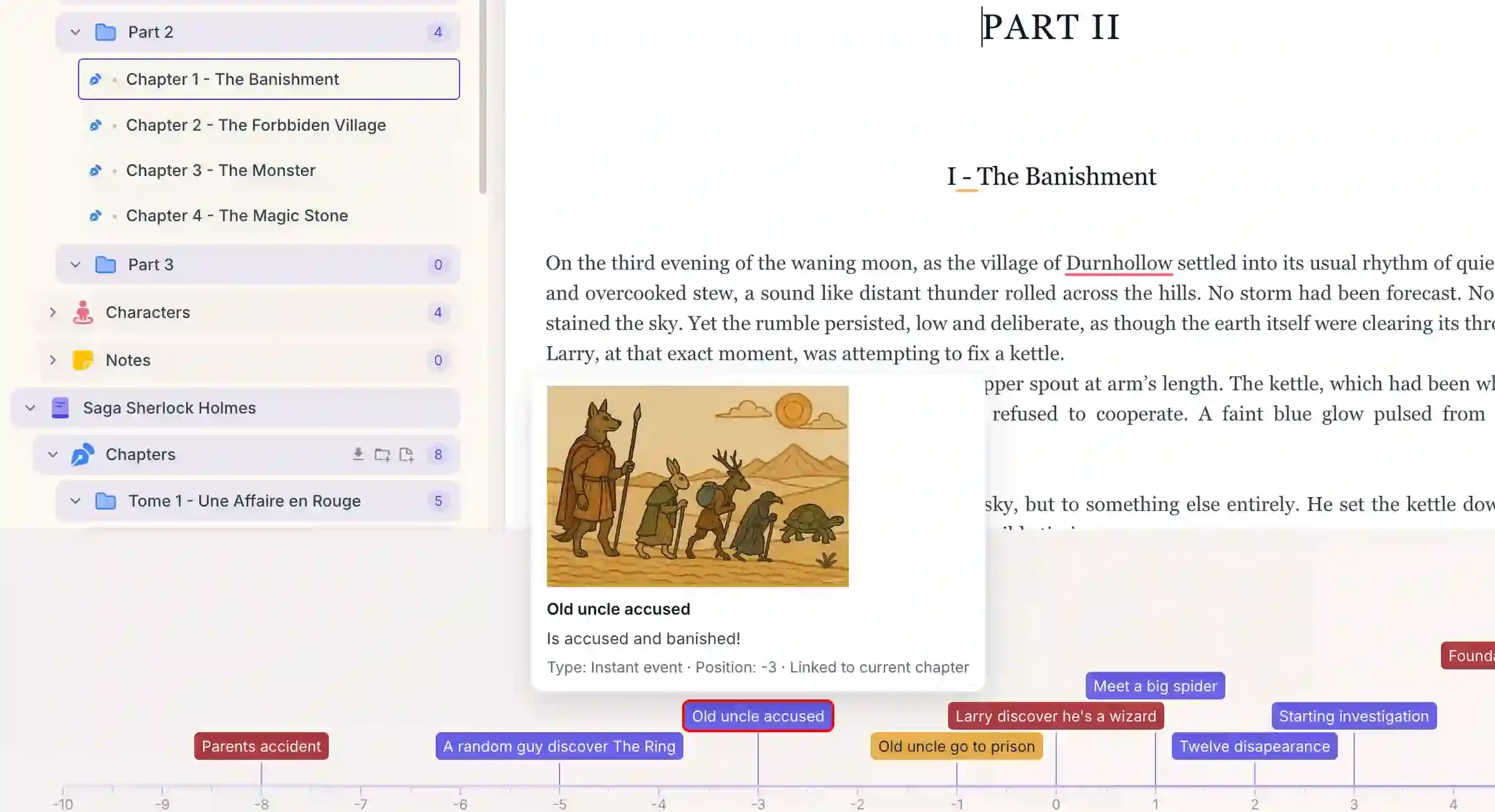
In Plumelisse, a timeline event can be linked to a chapter.
This connection creates a bridge between the chronological structure of the story and its narrative structure. You can identify the chapter in which an event is told even when that event belongs to a different time period.
A chapter set in the present may, for example, reveal something that happened twenty years earlier. The event remains positioned in the past on the timeline, while being linked to the chapter that reveals it.
This is particularly useful for flashbacks, memories, diaries, testimonies and delayed revelations.
It can also help you identify important events that have already been planned but are not yet included in any chapter.
Use the timeline before, during and after drafting
A timeline is not only a planning tool. It can support every stage of the writing process.
Before drafting, it helps you build the overall plot, arrange events and test the consistency of your outline.
During drafting, it acts as a reference. After completing an important scene, you can add its event or update the one you prepared earlier. The chronology then reflects the version of the story that has actually been written.
During revision, the timeline becomes a powerful checking tool. You can read events in their real chronological order and verify:
what each character knows at a given moment;
where every protagonist is located;
how much time passes between two scenes;
whether durations are believable;
whether each cause comes before its consequence;
whether ages and birthdays remain consistent;
whether parallel storylines progress at the right pace.
This chronological review often reveals issues that are difficult to detect when reading chapters only in narrative order.
Track different storylines separately
In a novel containing several narrative arcs, begin by identifying the events that belong to each storyline.
You might distinguish between:
the main plot;
the protagonists’ personal arcs;
the antagonist’s development;
political or historical events;
journeys;
clues and revelations.
The importance levels available with Plumelisse Premium can make major events stand out visually. Images can also provide quick reference points for a place, character, object or important stage of the story.
The goal is not to decorate the timeline, but to make the elements that structure the novel immediately visible.
Avoid the most common mistakes
The first mistake is adding too much detail. An overloaded timeline can become as difficult to understand as the manuscript it was meant to clarify. Focus on events that change the situation, affect a character or impose a chronological constraint.
The second mistake is creating the timeline once and never updating it. An initial outline almost always changes during the writing process. The chronology should reflect the current story, not an abandoned version of the plot.
The third mistake is recording only events that are shown directly. Some events happen outside the main narrative but still influence it significantly: the antagonist’s actions, an army’s movements, the spread of a rumour or a character’s secret preparations.
Finally, do not confuse the moment when the reader learns about an event with the moment when that event actually happened.
Adopt a lightweight routine
To keep your timeline useful without interrupting your writing flow, you can adopt a simple routine:
add the structural events during planning;
update the timeline after completing each chapter;
perform a complete check at the end of each part;
review the full chronology before the final revision.
From the Plumelisse editor, you can also add an event quickly through the command palette: press Ctrl + Space, followed by E.
It only takes a few seconds to record an event before returning to the manuscript.
Turn the timeline into your story’s external memory
The longer a project becomes, the harder it is to remember every journey, duration and chain of cause and effect. This is even more challenging in a series, an ensemble story or a novel built around numerous secrets.
The timeline then becomes an external memory for the novel. It allows you to concentrate on the writing itself without continually reconstructing the entire chronology in your mind.
**A good timeline does not replace imagination. It provides a strong enough framework for the story to become more complex without losing its consistency.**
Plumelisse brings your timeline, chapters, characters and notes together within the same project. Events remain close to the text they relate to instead of being scattered across several documents or applications.
You can explore Plumelisse’s other features or create your project to start organising the chronology of your next story.