
Writing a saga is not just about writing several books one after another. It means building a world that must remain consistent over time, with characters who evolve, events that have consequences, plotlines that may span several volumes and details that can quickly become difficult to remember.
In Plumelisse, the simplest way to manage a saga is to create one single project named after the saga, then organize the different books inside that project using chapter folders and subfolders.
**The main idea is simple: a Plumelisse project should represent the entire world of your saga, not just one individual volume**
This method allows you to keep your books, characters, notes and timeline in the same place. It is especially useful because characters and the timeline are attached to the project. If each volume is created as a separate project, you may end up scattering information that should remain shared across the whole saga.
Create a project named after the saga
The first step is to create a Plumelisse project with the global name of your saga. For example:
The Chronicles of Aryndel
The Ashes Cycle
The Last Kingdom Trilogy
Saga — Name of your world
This project becomes your central workspace. It does not represent only book one, but the entire series. Inside that same project, you can then organize your novels, structure your parts, write your chapters, track your characters and build your chronology.
This approach is especially useful if your saga includes:
several published or planned volumes;
characters who return from one book to another;
a long chronology, with past, present or future events;
secondary plots that continue across several books;
a rich world with places, families, factions or internal rules.
By keeping everything inside one project, you avoid recreating the same character sheets, copying notes from one project to another or maintaining multiple separate timelines.
Organize the books with folders
Once the project has been created, you can use chapter folders to represent each book in the saga.
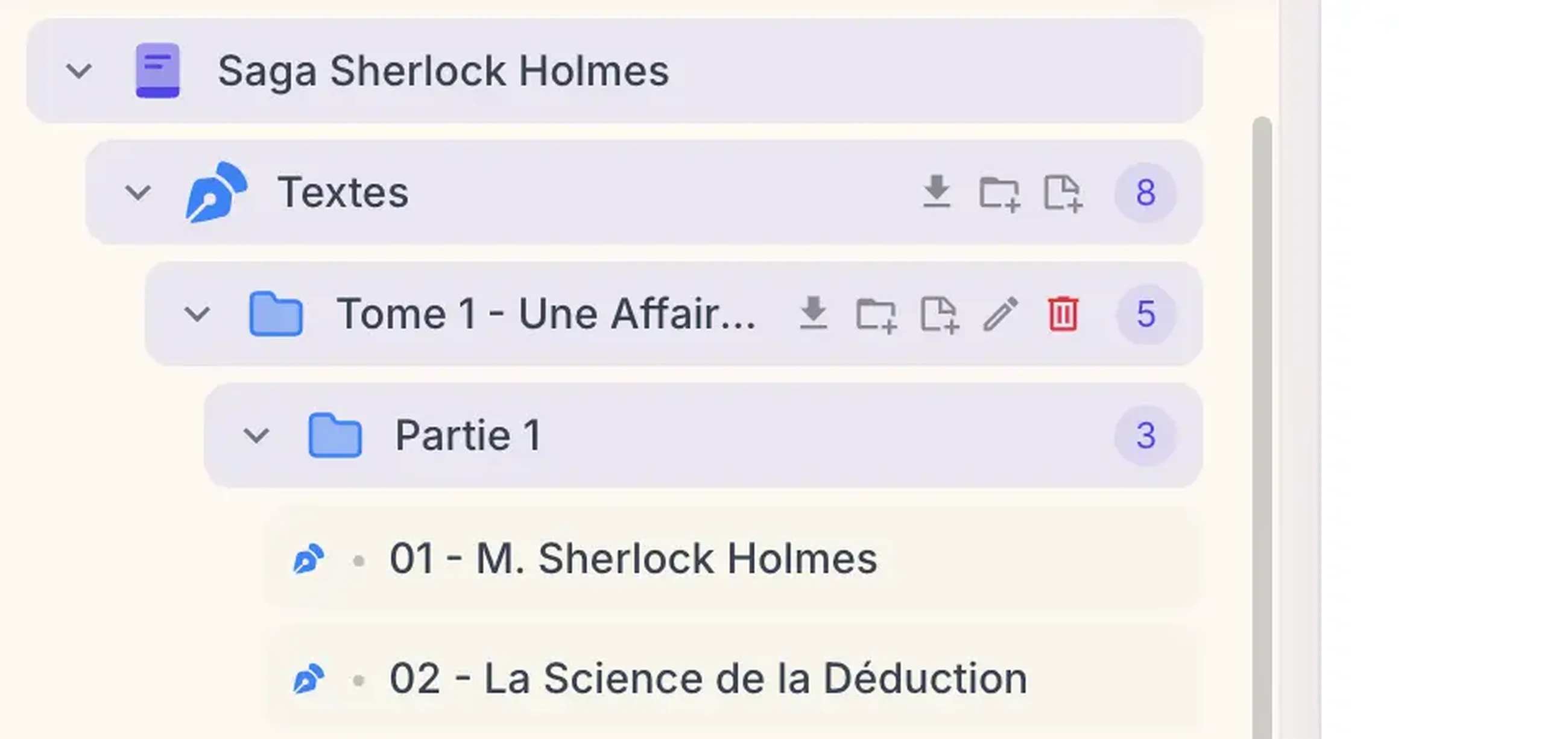
For example, inside your “The Chronicles of Aryndel” project, you could create a structure like this:
Book 1 — The Awakening of the Mists
Book 2 — The Broken Crown
Book 3 — The Oath of Shadows
Each first-level folder then corresponds to one book. This keeps your saga easy to read while preserving everything inside a single project.
Inside each book folder, you can choose the structure that fits your writing process.
A simple structure might look like this:
Book 1 — The Awakening of the Mists
Chapter 1
Chapter 2
Chapter 3
A more detailed structure could look like this:
Book 1 — The Awakening of the Mists
Part 1 — The Departure
Chapter 1
Chapter 2
Part 2 — The Crossing
Chapter 3
Chapter 4
Part 3 — The Revelation
Chapter 5
Chapter 6
You can also go further if your method requires it: acts, parts, narrative arcs, points of view, draft sections, moved scenes, temporary appendices and more. What matters is to keep a logic you will still understand several months later.
**A good structure is not necessarily the most detailed one. It is the one that helps you quickly find where to write and where to look for information**
Why avoid creating one project per volume?
Creating a separate project for each novel may seem natural at first. After all, each volume is a book. However, for a saga, this method can quickly become less practical.
If book one, book two and book three are in three separate projects, each project will have its own character space, notes and timeline. This can work if every book is fully independent, but it is not ideal for a continuous saga.
In a saga, a character may appear in book one, disappear in book two, return in book three, be mentioned in a flashback or influence an event long after their first appearance. If their sheet is isolated in the project for book one, you may lose that continuity.
With one project for the whole saga, your characters remain available no matter which volume you are working on. You can link them to different chapters, consult them while writing and keep a global view of their role in the story.
The same logic applies to the timeline. A saga often relies on a chronology that is broader than a single book: a character’s birth, an old war, the foundation of a kingdom, a past betrayal, a prophecy, an inciting event, a time jump between two books, a political or family consequence… All these elements benefit from being visible in one shared timeline.
Keep characters at saga level
One of the biggest advantages of this method is character management. In Plumelisse, characters belong to a project. If your project represents the entire saga, your characters naturally become shared elements across all your books.
This allows you to create a sheet for each important character, then use it throughout the whole saga.
You can use character sheets to track:
identity;
age or evolution;
role in the plot;
physical description;
goals;
secrets;
relationships;
evolution from one book to another;
chapters in which they appear.
For a saga, this kind of tracking is valuable. A secondary character in book one may become central in book three. An antagonist may change sides. A hero may grow older, lose a belief, receive a title, change names or carry the consequences of an old choice.
By centralizing characters in one project, you reduce the risk of inconsistencies. For example, you avoid accidentally changing a character’s eye color, forgetting an important injury or contradicting information from a previous volume.
You can also organize your characters into folders if your world contains many of them. Depending on your saga, these folders may represent:
protagonists;
antagonists;
families;
kingdoms;
factions;
creatures;
deceased characters;
secondary characters;
characters specific to one volume.
The most important thing is to keep an organization that supports the writing process, not just one that looks neat. If you often search for characters by faction, organize them by faction. If you search for them by first appearance, organize them that way. The tool should follow your author logic.
Use one shared timeline for the whole saga
The timeline is the other major reason to create one single project for a saga. In a short or standalone novel, a simple chronology may be enough. In a saga, events accumulate and eventually become the narrative backbone of the whole story.
A shared timeline helps you visualize what happens before, during and between the different books.
You can place in it:
historical events from your world;
events before book one;
major scenes from each novel;
time jumps between volumes;
deaths, births, revelations or betrayals;
battles, journeys, investigations or political changes;
events linked to a specific chapter;
events that matter for a character.
This overview is especially useful when your saga contains flashbacks, ancient secrets, parallel plotlines or characters who do not experience events in the same order.
For example, you may have an event called “Fall of the capital” that happened long before the story begins, but is only revealed in book two. You may also have a promise made in book one, forgotten by the reader during part of book two, then fulfilled in book three. By centralizing these events, you keep a clear record of what exists in the story, even if the reader discovers it later.
**The timeline is not only there to show when things happen. It also helps you understand the consequences of each event across the entire saga**
Manage notes to prepare your world
In addition to chapters, characters and the timeline, notes can become a very useful space for building your saga. You can use them to store anything that does not yet belong in a chapter.
For example:
magic rules;
political systems;
detailed chronology;
family trees in text form;
ideas for future scenes;
revelations to place later;
location details;
invented vocabulary;
themes for each volume;
questions to solve during revision.
You can keep some notes at project level, especially when they concern the whole saga. Other notes can be linked to specific chapters if they directly support a scene or sequence.
This distinction matters: not all information needs to appear everywhere with the same weight. A global note may concern the entire world, while a chapter note may remind you of a specific intention, an emotion to strengthen or a detail to check during revision.
Example of a complete structure in Plumelisse
Here is one possible structure for a three-book saga:
Project: The Chronicles of Aryndel
Chapters
Book 1 — The Awakening of the Mists
Part 1 — The Village
Part 2 — The Escape
Part 3 — The First War
Book 2 — The Broken Crown
Part 1 — The Return
Part 2 — The Alliances
Part 3 — The Siege
Book 3 — The Oath of Shadows
Part 1 — The Ruins
Part 2 — The Choice
Part 3 — The Last Pact
Characters
Protagonists
Antagonists
Royal Family
Allies
Secondary Characters
Notes
Worldbuilding
Magic
Politics
Ideas for future books
Revision
Timeline
Ancient History
Book 1 Events
Events Between Volumes
Book 2 Events
Book 3 Events
This structure is only an example. A short saga may only need one folder per book with chapters directly inside. A more complex saga may use parts, subparts and more precise working folders.
The goal is not to build the perfect architecture on day one. The goal is to create a stable base that you can adapt as the writing progresses.
A few tips to keep a saga consistent
Even with a good tool, a saga requires a regular method. The hardest part is not always finding new ideas, but keeping track of the promises you have already made.
Get into the habit of updating your character sheets whenever something important changes: an injury, a revelation, a relationship, a title, a fear, a goal. This will help you avoid rereading several chapters just to find one piece of information.
Add major events to the timeline as you go, even if you do not know all the details yet. You can refine them later. An imperfect but living timeline is better than a perfect chronology you never update.
You can also keep a note dedicated to open questions. For example: “Why does this character lie?”, “When should the origin of the prophecy be revealed?”, “Which clue should be planted in book one to prepare book three?” This note becomes a narrative dashboard while you write.
Finally, think about emotional consistency as much as factual consistency. A saga is not only built on dates and events. It is also built on the gradual transformation of its characters. In each volume, ask yourself what your characters know, what they believe, what they have lost, what they still want and what they refuse to admit.
In summary
To manage a book saga in Plumelisse, the most effective method is to create a single project named after the saga, then organize the volumes with folders and subfolders. This structure keeps characters, notes and the timeline inside the same workspace.
You can then create a first level of folders for the books, followed by parts, chapters or deeper structures depending on your method. This organization helps you write each volume without losing sight of the bigger picture.
**A saga becomes stronger when everything stays connected: characters, events, chapters, notes and narrative consequences**
Plumelisse helps you preserve that continuity. Instead of scattering your world across several projects, you can build one central workspace for your entire saga, then move forward volume after volume with a clear, flexible structure that adapts to the way you write.